
Yesterday was a mix of emotions.
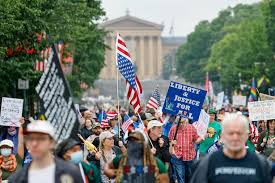
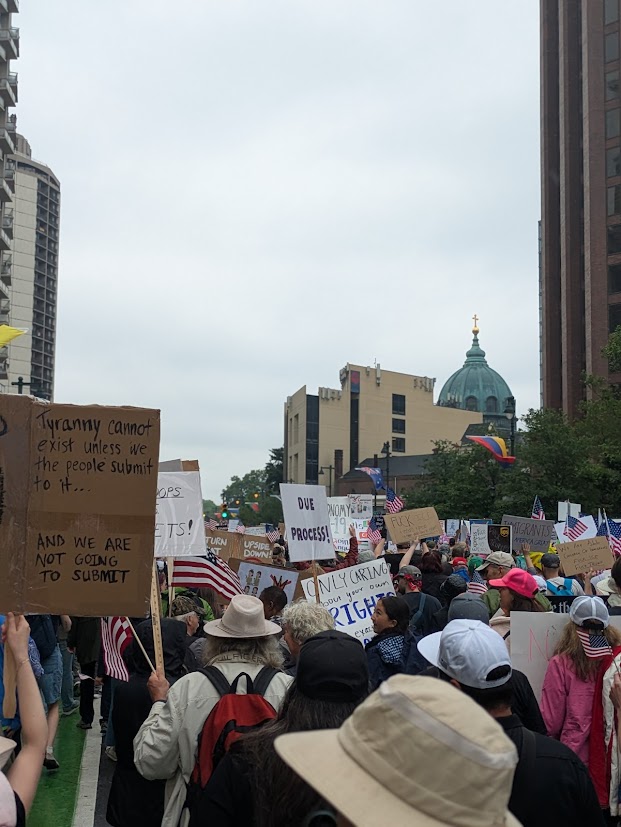
As I parked to join a “pre-game” rally in my small town, people gathering to take the train into Philly, I heard the noise before I saw it. Rounding the corner, the size of the crowd struck me. Over 600 people (a very rough estimate) were lining the main street and courtyard, cheering, chanting. People of all kinds: Black, brown, white, old, young, disabled, LGBTQIA+.
Tears welled up in my eyes.
I’ve been living in survival mode during this administration. People close to me are being targeted, denied their existence. Research that could help loved ones has been canceled. My immigrant students are afraid. It’s personal. So to see this crowd, to feel the energy of people showing up to protect democracy? It was beautiful. It was energizing.
Protests, rallies, and awareness marches aren’t new to me. My first was the AIDS Walk in 1993, when I was a junior in high school. Back then, AIDS was still widely stigmatized as “that gay disease,” and queerness was far more “othered” than it is today. Every step of that walk felt purposeful—a balance between hope and mourning. I participated for years, and it always felt the same: brutally sad, yet somehow hopeful.
Yesterday felt like that.
I cried tears of joy when I saw the crowd out of pure optimism. And I cried tears of sadness and fear when I heard about the political assassinations in Minnesota.
Every step felt like an oxymoron: pride in what we were demonstrating, in our numbers, in using our voices against madness, and also profound sorrow. Sorrow that we’re slipping toward totalitarianism. Sorrow for those close to me who didn’t come out to demonstrate with me, for understandable, legitimate fear. Sorrow for those living a brutal nightmare under this government.
I was devastated. And I was hopeful.
And then I learned we did it: 12.1 million people participated. That’s 3.5% of the U.S. population. This is the threshold researchers say is needed for a government to be forced to respond.
The message is clear: people are standing up for our Constitution, for democracy, and against the very real threats facing both. People are rising. I spoke with conservatives at our small-town rally, people who’ve never protested before, but showed up because what’s happening is too dangerous to ignore.
And yet…
If you know me, you know I actively seek out criticism of both myself and of movements I’m part of. I listen. I don’t get defensive (unless it’s wildly off-base or hypocritical). Growth comes from grappling with discomfort. We can take what’s useful, discard what isn’t, and clarify our values.
So a few days before No Kings Day, I started reading critiques:
That this wasn’t really a protest, but a rally.
That real protests disrupt. They inconvenience, they’re not permitted, they’re reactive and organic, they interrupt the flow of money.
Rallies and demonstrations have value in community, visibility, a show of numbers—but they’re not disruption.
And then I saw the man at No Kings Day. Standing still in a moving crowd, holding a sign he flipped back and forth. One side read, “Mass protests don’t work.” The other: “Until you disrupt the flow of money.”
These criticisms are valid. Like it or not, we live in a capitalist system. Money talks. Without general strikes, without halting commerce, without disrupting the money pipeline into politics, change is slow.
There’s another critique: that this was just another example of our influencer culture. That our clever signs were designed for Instagram. That this was performative, whitewashed. That while fascism is on the march, while people are dying and losing their freedoms, we’re marching and feeling good about ourselves. That the demonstration yesterday lacked the seriousness to really meet the reality of the situation.
And I wrestle with that, too.
Much of this doesn’t feel like enough. The crowd came together out of shared anger and concern, but the march itself felt… celebratory. Lighter than the moment demands.
But there was value in it. No Kings Day got people engaged. People showed up. Many overcame fear, especially those participating for the first time. They took that step, even as warnings about ICE, police, counter-protesters swirled.
That matters.
Still, the criticism is necessary. We need to become more nimble. We need to act quickly in response to shifting conditions. We can’t rely solely on weeks-long planning for permitted actions.
We need to escalate. To disrupt, not with violence, but by halting the flow of money and business as usual. That’s what puts pressure on those in power, from corporations to elected officials.
We have a choice right now.
We can celebrate that we did it. Or we can say: this was step one.
We will fail if we stay in this moment. If most of us don’t stay involved. If we don’t evolve. If we don’t push ourselves to do the next uncomfortable thing this moment demands.
Because fascism is on the rise.
People’s lives are being upended.
Political assassinations and attempts are happening.
Rights are being stripped.
Stay involved.
Stay angry.
Stay engaged.
Get comfortable being uncomfortable.
The future depends on it.
(More on actions you can take in a future post.)